Solder Paste Printing
High-precision solder paste dispensing for electronics development and PCB prototyping
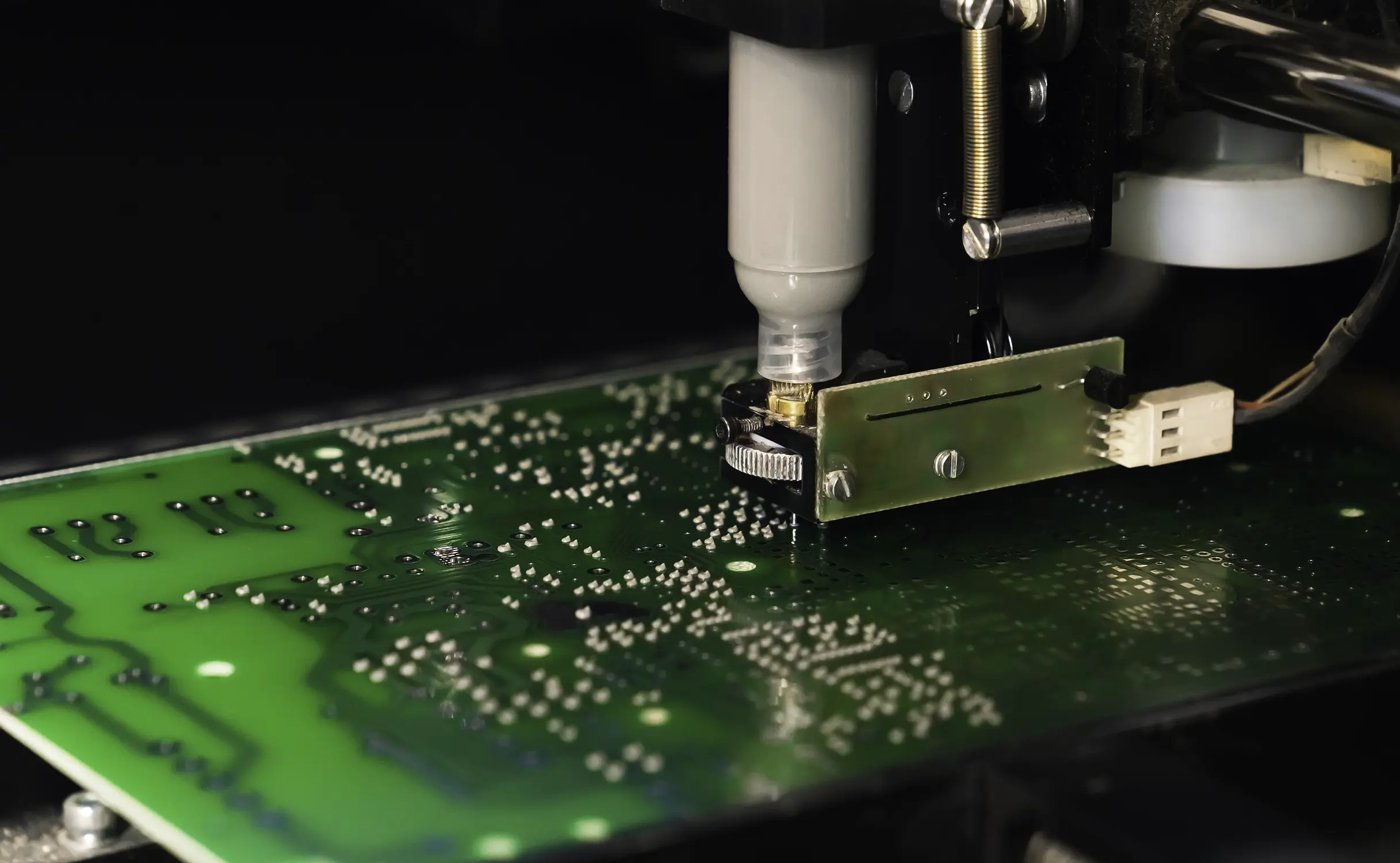
Solder Paste Printing
High-precision solder paste dispensing for electronics development and PCB prototyping
Solder paste is a material used to secure electronic components onto printed circuit boards (PCBs) or flexible substrates. It is essentially powdered solder suspended in a flux medium, which helps clean the surfaces being soldered and facilitates the melting and bonding of the solder.
Once the components are positioned, the solder paste is heated until it melts and solidifies, creating strong electrical and mechanical connections between the circuit and the components. Solder paste application is crucial for surface-mount technology (SMT) assembly, where components are mounted directly onto the surface of the board.

APPLICABLE INDUSTRIES
- Aerospace
- Automotive
- Consumer electronics
- Medical equipment
- Semiconductor
COMMON MATERIALS
- No-clean flux
- Rosin-based flux
- Tin-bismuth alloys
- Tin-lead alloys
COMMON SUBSTRATES
- Ceramic
- Glass
- FR1
- FR4
- Polymers
- Silicon wafers
- Thermoplastic polyurethane (TPU)
INDUSTRY
INDUSTRY
FUTURE OUTLOOK
FAST FACTS
Frequently asked questions
For high-quality solder joints, both the dispensing system and printed circuit board should be clean. Wipe the board with a lint-free material to prevent contamination that can cause solder paste residue or poor paste deposits during the production process.
One of the advantages of using V-One for direct ink writing (DIW) solder paste dispensing is its precise control over pad selection and paste volume. You can choose exactly which pads to print on and adjust the amount of your selected solder paste for each, making it ideal for fine-feature applications and ensuring a repeatable and reliable process.Solder paste must be carefully stored in a sealed container to preserve its shelf life and prevent changes to its behavior. If solder paste absorbs moisture or dries out, it can lead to excessive solder paste residue, a poor paste deposit, or performance issues during the soldering process. Before dispensing, it’s critical to handle solder paste under stable ambient temperature conditions and, when necessary, verify characteristics with a simple coalescence test.
Traditional solder printing machines rely heavily on stencil apertures and squeegee pressure, which can lead to poor deposition or assembly defects if not controlled correctly. In contrast, direct ink writing (DIW) solder paste dispensing methods eliminate issues such as stencil wear and disproportionate downward force. By dispensing material directly where needed, DIW systems enable a more consistent process without dependency on print stroke accuracy or snap-off timing, making them ideal for fine-feature applications and prototyping.
There are multiple approaches to solder paste printing when prototyping PCBs, each with its own set of challenges. In traditional screen printing, several key parameters directly impact solder paste printing quality, including squeegee pressure, squeegee angle, print speed, stencil separation speed, and solder paste viscosity. Incorrect settings — such as failing to apply sufficient pressure — can cause printing defects like misalignment, poor paste deposits, or incomplete transfers.
However, direct ink-writing (DIW) solder paste dispensing avoids these challenges by eliminating the need for squeegees and stencils. DIW systems focus on controlled solder paste deposits directly on the PCB, helping achieve a reliable and repeatable process while reducing the risk of misalignment. Additionally, maintaining the right ambient temperature and relative humidity in the environment also ensures the solder paste can flow evenly during application, helping achieve a reliable and repeatable process.
For high-quality solder joints, both the dispensing system and printed circuit board should be clean. Wipe the board with a lint-free material to prevent contamination that can cause solder paste residue or poor paste deposits during the production process.
One of the advantages of using V-One for direct ink writing (DIW) solder paste dispensing is its precise control over pad selection and paste volume. You can choose exactly which pads to print on and adjust the amount of your selected solder paste for each, making it ideal for fine-feature applications and ensuring a repeatable and reliable process.Traditional solder printing machines rely heavily on stencil apertures and squeegee pressure, which can lead to poor deposition or assembly defects if not controlled correctly. In contrast, direct ink writing (DIW) solder paste dispensing methods eliminate issues such as stencil wear and disproportionate downward force. By dispensing material directly where needed, DIW systems enable a more consistent process without dependency on print stroke accuracy or snap-off timing, making them ideal for fine-feature applications and prototyping.
Solder paste must be carefully stored in a sealed container to preserve its shelf life and prevent changes to its behavior. If solder paste absorbs moisture or dries out, it can lead to excessive solder paste residue, a poor paste deposit, or performance issues during the soldering process. Before dispensing, it’s critical to handle solder paste under stable ambient temperature conditions and, when necessary, verify characteristics with a simple coalescence test.
There are multiple approaches to solder paste printing when prototyping PCBs, each with its own set of challenges. In traditional screen printing, several key parameters directly impact solder paste printing quality, including squeegee pressure, squeegee angle, print speed, stencil separation speed, and solder paste viscosity. Incorrect settings — such as failing to apply sufficient pressure — can cause printing defects like misalignment, poor paste deposits, or incomplete transfers.
However, direct ink-writing (DIW) solder paste dispensing avoids these challenges by eliminating the need for squeegees and stencils. DIW systems focus on controlled solder paste deposits directly on the PCB, helping achieve a reliable and repeatable process while reducing the risk of misalignment. Additionally, maintaining the right ambient temperature and relative humidity in the environment also ensures the solder paste can flow evenly during application, helping achieve a reliable and repeatable process.